Export 422 results:
Sort by: Author Title Type [ Year  (Desc)]
2026
Pacheco, João Nuno, Francisco Capucha, António Pinho Ramos, Alejandro Enfedaque, Carla Marchão, Dario Coronelli, Duarte Faria, Jorge de Brito, Luca Martinelli, Luciano Nuccio, Marco Lamperti, Miguel Fernandez Ruiz, Monica Lavagna, and Rui Marreiros. "Recycled aggregate incorporation and drop panel design for flat slab concrete structures: Environmental benefits through life cycle assessment (Project ERIES-RecycleSlab)." fib Symposium. 2026. 432-442. Abstract
n/a
Ng, Kevin W., Jesse Boumelha, Katey S. S. Enfield, Jorge Almagro, Hongui Cha, Oriol Pich, Takahiro Karasaki, and others. "Retraction Note: Antibodies against endogenous retroviruses promote lung cancer immunotherapy." Nature. 649 (2026): 1330. AbstractWebsite
n/a
Ramos, António, Alejandro Enfedaque, Carla Marchão, Dario Coronelli, Duarte Faria, Fausta Fiorillo, Georgios Tsionis, Gianpaolo Rosati, Jaroslav Halvonik, Javier Molina, João Pacheco, Jorge de Brito, Luca Martinelli, Luciano Nuccio, Marco Lamperti, Marco Peroni, Miguel Fernandez Ruiz, Robert Vollum, Rui Marreiros, and Simone Peloso. "Structural Behaviour of Recycled Aggregate Reinforced Concrete Flat Slabs with Drop Panels under Seismic and Cyclic Actions (Project ERIES-RecycleSlab)." fib Symposium. 2026. 391-400. Abstract
n/a
2025
Rotatori, Filippo Maria, Fernando Escaso, Bruno Camilo, Filippo Bertozzo, Elisabete Malafaia, Octávio Mateus, Pedro Mocho, Francisco Ortega, and Miguel Moreno-Azanza and. "Evidence of large-sized ankylopollexian dinosaurs (Ornithischia: Iguanodontia) in the Upper Jurassic of Portugal." Journal of Systematic Palaeontology. 23 (2025): 2470789. Abstractevidence_of_large-sized_ankylopollexian_dinosaurs__ornithischia__iguanodontia__in_the_upper_jurassic_of_portugal.pdfWebsite

The Upper Jurassic beds of the Lusitanian Basin in central Portugal yield diverse dinosaurian fauna, dated to the Kimmeridgian–Tithonian interval. Saurischian dinosaurs are, overall, more abundant than their ornithischian counterparts, in terms of both specimens collected and species recognized. Iguanodontians are so far represented by the styracosternan Draconyx loureiroi, the dryosaurid Eousdryosaurus nanohallucis and the enigmatic dryomorphan Hesperonyx martinhotomasorum. Here we aim to highlight the diversity of this clade in the Late Jurassic of Portugal, presenting evidence for yet another species of ankylopollexian iguanodontian dinosaur, represented by the specimen SHN.JJS.015, which is housed at the Sociedade de História Natural, Torres Vedras. Detailed comparisons rule out attribution to previously known taxa, and phylogenetic analyses that include SHN.JJS.015 indicate early-diverging ankylopollexian affinities for this specimen. As there is no robust diagnosis, we do not erect a new formal species for it at this stage. Nevertheless, this specimen represents a previously unreported taxon that highlights greater diversity than previously estimated among the iguanodontians of the Late Jurassic and highlights the importance of Europe in diversification and dispersal events of this clade. A series of smaller, isolated femora from the same sub-basin as SHN.JJS.015 may represent the same taxon, presenting evidence of thriving communities of ankylopollexians during the Kimmeridgian–Tithonian interval in Portugal.

Jiangzuo, Qigao, Joan Madurell-Malapeira, Xinhai Li, Darío Estraviz-López, Octávio Mateus, Agnès Testu, Shijie Li, Shiqi Wang, and Tao Deng. "Insights on the evolution and adaptation toward high-altitude and cold environments in the snow leopard lineage." Science Advances. 11 (2025): eadp5243. Abstractinsights_on_the_evolution_and_adaptation_toward_high-altitude_and_cold_environments_in_the_snow_leopard_lineage.pdfWebsite

How snow leopard gradually adapted to the extreme environments in Tibet remains unexplored due to the scanty fossil record in Tibet. Here, we recognize five valid outside-Tibet records of the snow leopard lineage. Our results suggest that the snow leopard dispersed out of the Tibetan Plateau multiple times during the Quaternary. The osteological anatomy of the modern snow leopard shows adaptation to the steep slope and, to a lesser extent, cold/high-altitude environment. Fossils and phylogeny suggest that the snow leopard experienced a gradual strengthening of such adaptation, especially since the Middle Pleistocene ( 0.8 million years). Species distribution modeling suggests that the locations of the fossil sites are not within most suitable area, and we argue that local landscape features are more influential factors than temperature and altitude alone. Our study underscores the importance of integrating morphology, fossil records, and species distribution modeling, to comprehensively understand the evolution, ecology, and inform conservation strategies for endangered species. Integrated morphology, fossil records, and SDM reveal the evolution and adaptation in the snow leopard lineage.

Whittaker, Lisa, Elena Espinosa-Cabrera, Helen Haar, Elly Hall, Sophie Lambert, Jesse Tristram, Michaela Vladykova, and others. "Podcasts as a platform for sharing and disseminating experiences and expertise between young adults with cancer and radiotherapy researchers." Research Involvement and Engagement (2025). AbstractWebsite
n/a
Ramos, António, Carla Marchão, João Nuno Pacheco, Alejandro Enfedaque, Dario Coronelli, Duarte Faria, Jorge de Brito, Miguel Fernández Ruiz, and Rui Marreiros. "A review of punching behavior of slab–column connections with recycled coarse aggregate concrete." Structural Concrete. 26 (2025): 1388-1401. AbstractWebsite
n/a
2024
Kiazadeh, Asal, Jonas Deuermeier, Emanuel Carlos, Rodrigo Martins, Sérgio Matos, \{Fábio Martinho\} Cardoso, and \{Luís Manuel\} Pessoa. "Concept paper on novel radio frequency resistive switches." NANOARCH '23. Eds. Ronald Tetzlaff, Fernando Corinto, Neil Kemp, Alon Ascoli, Andreas Mögel, \{Meng-Fan(Marvin)\} Chang, \{Joseph S. \} Friedman, Siting Liu, \{John Paul\} Strachan, Stephan Menzel, \{Mehdi B. \} Tahoori, Martin Ziegler, Jason Eshraghian, Ioannis Messaris, Christian Koitzsch, Thomas Mikolajick, and Vasileios Ntinas. Nanoarch: IEEE/ACM International Symposium on Nanoscale Architectures. United States: ACM - Association for Computing Machinery, 2024. 1-3. Abstract

For reconfigurable radios where the signals can be easily routed from one band to another band, new radio frequency switches (RF) are a fundament. The main factor driving the power consumption of the reconfigurable intelligent system (RIS) is the need for an intermediate device with static power consumption to maintain a certain surface configuration state. Since power usage scales quadratically with the RIS area, there is a relevant interest in mitigating this drawback so that this technology can be applied to everyday objects without needing such a high intrinsic power consumption. Current switch technologies such as PIN diodes, and field effect transistors (FETs) are volatile electronic devices, resulting in high static power. In addition, dynamic power dissipation related to switching event is also considerable. Regarding energy efficiency, non-volatile radio frequency resistive switch (RFRS) concept may be better alternative solution due to several advantages: smaller area, zero-hold voltage, lower actuation bias for operation, short switching time, scalability and capable to be fabricated in the backend-of-line of standard CMOS process.

Sharma, Himanshu, Nathan Jespersen, Kai Ehrenbolger, Lars-Anders Carlson, and Jonas Barandun. "Ultrastructural insights into the microsporidian infection apparatus reveal the kinetics and morphological transitions of polar tube and cargo during host cell invasion." PLOS Biology. 22 (2024): e3002533. AbstractWebsite
n/a
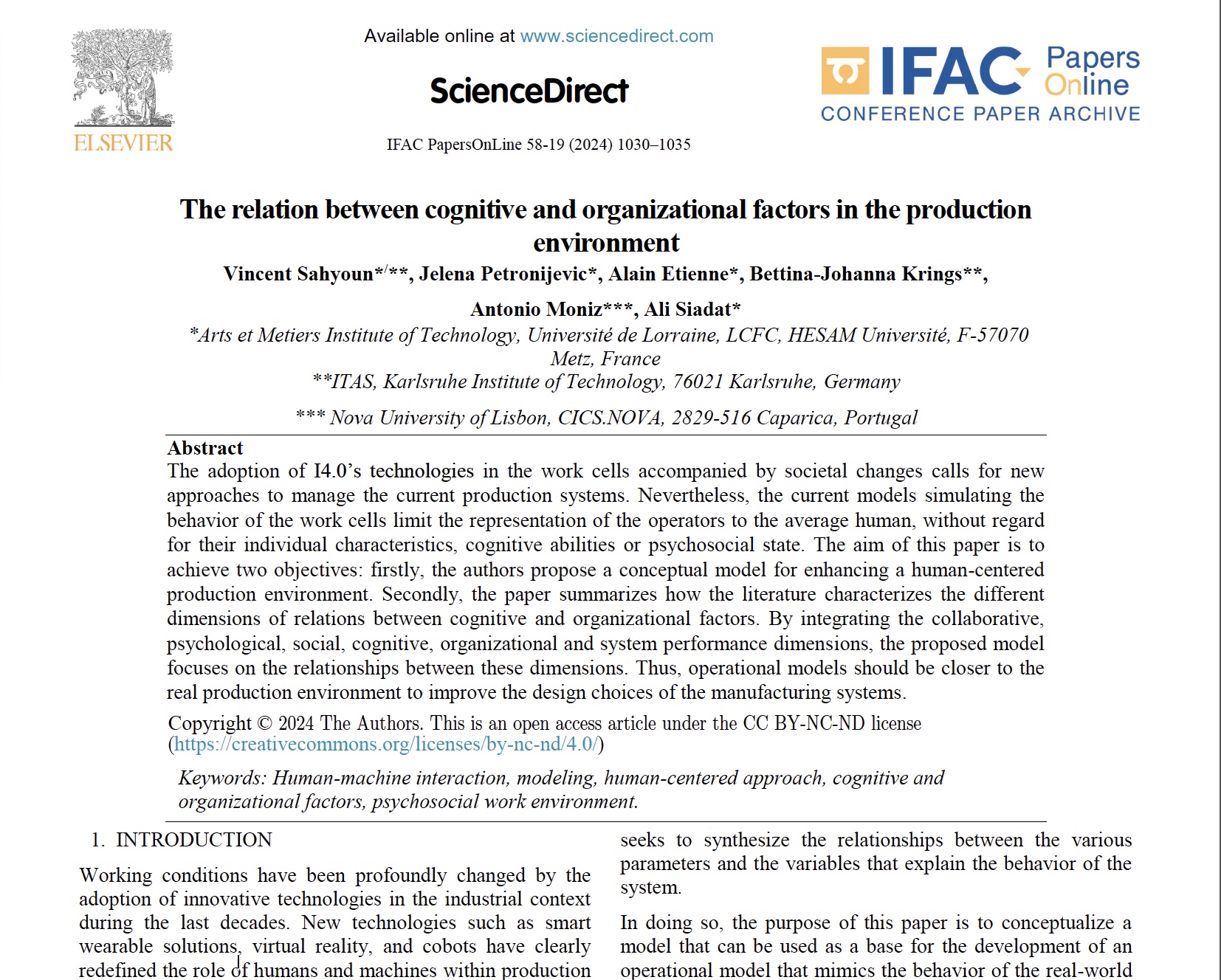
Sahyoun, Vincent, Jelena Petronijevic, Alain Etienne, Bettina-Johanna Krings, António B. Moniz, and Ali Siadat. "The relation between cognitive and organizational factors in the production environment." IFAC PapersOnLine. 58.19 (2024): 1030-1035. Abstractcognitive_and_organizational_factors_ifac24.pdfarticle_ifac_2024.jpgWebsite

The adoption of I4.0’s technologies in the work cells accompanied by societal changes calls for new approaches to manage the current production systems. Nevertheless, the current models simulating the behavior of the work cells limit the representation of the operators to the average human, without regard for their individual characteristics, cognitive abilities or psychosocial state. The aim of this paper is to achieve two objectives: firstly, the authors propose a conceptual model for enhancing a human-centered production environment. Secondly, the paper summarizes how the literature characterizes the different dimensions of relations between cognitive and organizational factors. By integrating the collaborative, psychological, social, cognitive, organizational and system performance dimensions, the proposed model focuses on the relationships between these dimensions. Thus, operational models should be closer to the real production environment to improve the design choices of the manufacturing systems.

Eduardo Costa Camilo, Beatriz Rovisco, Isabel Duarte Carla Pinheiro Graça Carvalho P. Soup was an emotional trigger., 2024. Abstract

n/a

Viñas-Ospino, Adriana, Ana Rita Jesus, Alexandre Paiva, Maria J. Esteve, Ana Frígola, Jesús Blesa, and Daniel López-Malo. "Comparison of green solvents for the revalorization of orange by-products: Carotenoid extraction and in vitro antioxidant activity." Food Chemistry. 442 (2024): 138530. AbstractWebsite

Orange peels contain a considerable number of bioactive compounds such as carotenoids, that can be used as ingredients in high-value products. The aim of this study was to compare orange peel extracts obtained with different green solvents (vegetable oils, fatty acids, and deep eutectic solvents (DES)). In addition, the chemical characterization of a new hydrophobic DES formed by octanoic acid and l-proline (C8:Pro) was performed. The extracts were compared in terms of carotenoid extraction, antioxidant activity by three methods, color, and environmental impact. The results confirmed that the mixture of C8:Pro is a DES and showed the highest carotenoid extraction (46.01 µg/g) compared to hexane (39.28 µg/g). The antioxidant activity was also the highest in C8:Pro (2438.8 µM TE/mL). Finally, two assessment models were used to evaluate the greenness and sustainability of the proposed extractions. These results demonstrated the potential use of orange peels in the circular economy and industry.

Akalin, S. A., M. Erol, B. Uzunbayir, S. Oguzlar, S. Yildirim, F. P. Gokdemir Choi, S. Gunes, U. D. Yilmazer Menda, and MJ Mendes. "Physically-Deposited Hole Transporters in Perovskite PV: NiOx Improved with Li/Mg Doping." Advanced Materials Technologies. 9 (2024). AbstractWebsite
n/a
2023
Guerra-Guimarães, Leonor, Jéfyne Carrera, Marina Rosário do Santos, Carla Pinheiro, Manzur E-MohsinaFerdous, Inês Diniz, Andreia Loureiro, and et al. "Assessment of carbon metabolism of Coffee Kawisari hybrid challenged by Hemileia vastatrix, the causal agent of Coffee Leaf Rust.". 2023. Abstract
n/a
Pinheiro, Carla, Giovanni Emiliani, Giovanni Marino, Ana S. Fortunato, Matthew Haworth, Anna De Carlo, Maria Manuela Chaves, Francesco Loreto, and Mauro Centritto. "Metabolic Background, Not Photosynthetic Physiology, Determines Drought and Drought Recovery Responses in C3 and C2 Moricandias." International Journal of Molecular Sciences. 24 (2023): 4094. AbstractWebsite
n/a
Carrelo, Henrique, André R. Escoval, Tânia Vieira, Mercedes Jiménez-Rosado, Jorge Carvalho Silva, Alberto Romero, Paula Isabel P. Soares, and João Paulo Borges. "Injectable Thermoresponsive Microparticle/Hydrogel System with Superparamagnetic Nanoparticles for Drug Release and Magnetic Hyperthermia Applications." 9.12 (2023): 982. Abstract
n/a
Silva, Ana B. P., Ana R. Jesus, Daniela A. S. Agostinho, José M. S. S. Esperança, Alexandre Paiva, Ana R. C. Duarte, and Patrícia M. Reis. "Using dicationic ionic liquids to upgrade the cytotoxicity and solubility of poorly water-soluble drugs." 3.1 (2023): 100052. AbstractWebsite

New dicationic ionic liquids (DcILs) based on carboxylic acid-derived, N-acetyl amino acid-derived or bromide anions, and ammonium cations were synthesized and characterized. DcILs were employed as co-solvents to improve the solubility of ibuprofen and ketoprofen belonging to BCS class II. These DcILs demonstrated to be less cytotoxic towards fibroblasts L929 cells and contributed to an augment in the solubility of both drugs when compared with monocationic ionic liquids (McILs). The cytotoxic profile of some of these ILs was established, and when the linker between two ammonium cations was an ether group or a short alkyl chain an IC50 higher than 200 mM for fibroblasts L929 cells was achieved. The anion structure showed to be a key factor in the solubility of both drugs, being the family of carboxylic acid-derived, the one that presented the most significant effect, followed by N-acetyl amino acid-derived and finally bromide. The two dimensional 1H1H– NOESY NMR spectra showed the interaction between the IL and the two oral drugs, responsible for the improvement of their solubility. The lipophilicity (logP) of ibuprofen and ketoprofen reduced in the presence of these new DcILs.

Coimbra, Rute, Miguel Moreno-Azanza, Lope Ezquerro, Carmen Nuñez-Lahuerta, José Manuel Gasca, Adrian Immenhauser, Octávio Mateus, and Fernando Rocha. "Evaluating and comparing geochemical sampling protocols in dinosaur eggshells: refining Cretaceous ecosystem research." Cretaceous Research (2023): 105632. Abstractsingle_file_coimbra_et_al._2023_cretresearch.pdfWebsite

The geochemical signatures of dinosaur eggshells represent well-established proxies in paleoenvironmental and paleobiological research. The variable sampling procedures reported in the literature, however, deserve attention. In order to evaluate the impact of different sampling methodologies on carbon and oxygen isotope and elemental concentrations, grinding was contrasted with drilling to extract powder samples from eggshell fragments collected at several locations. Eggshell data were further contrasted with surface materials, encasing matrix and compared with independent proxies using petrographic and elemental techniques. Iron and manganese elemental concentrations revealed an enrichment sequence depending on the sampling strategy for the same eggshell fragment. This pattern can be mistaken for a variable state of preservation. In contrast, carbon and oxygen isotope values exhibited only subtle differences and lacked clear trends. This suggests that isotope data are less susceptible to different methodological approaches. It is shown that drilling offers a wider range of possibilities compared to grinding (e.g., faster and less destructive). Additionally, drilled powder samples can confidently be used for elemental and isotope analysis, excluding contamination, thus providing a more accurate set of proxy data from eggshell archives.

Crespo, Vicente D., Cristina Sequero López, Maria Rios, Darío Estraviz López, Arturo Gamonal, Roberta Martino, Marc Riccetto, Pedro Callapez, Paulo Legoinha, and Octávio Mateus. "Revisiting the classical small mammal assemblage from the Eocene site of Silveirinha: a fresh look at old collections." XI Congresso Nacional de Geologia: Geociências e Desafios globaisAt: Universidade de CoimbraVolume: Livro de Resumos, págs 85-86. Coimbra 2023. Abstractcrespov_etal_xicng2023_silveirinha.pdf

O sítio de Silveirinha é uma das localidades de mamíferos mais conhecidas da Paleontologia do Cenozoico de Portugal e da Europa em geral. Graças à sua rica e diversificada associação de mamíferos, com mais de 30 taxa, foi posicionado no Eocénico inferior (início do Ypresiano, MP7, ca. 55,8 M.a.), sendo o local mais antigo da Europa desta Época, devido à presença única de taxa típicos do Paleocénico superior, juntamente com outras espécies já características do Eocénico inferior. Este estudo irá rever o material de pequenos mamíferos deste sítio, conservado na coleção clássica da Universidade Nova de Lisboa, a fim de fazer uma actualização taxonómica à luz das publicações mais recentes.

Guillaume, Alexandre R. D., Lope Ezquerro, Miguel Moreno-Azanza, and Octávio Mateus. "Vertebrate microfossil assemblages from the Lourinhã Formation: a sneak peek on the paleoecology of the Late Jurassic in Portugal." The Anatomical Record. 306.#S1 (2023): 118-121. Abstractguillaume_et_al_2023_vertebrate_microfossil.pdf

n/a

2022
Mateus, Octávio, and Darío Estraviz-López. "A new theropod dinosaur from the early cretaceous (Barremian) of Cabo Espichel, Portugal: Implications for spinosaurid evolution." PLOS ONE. 17 (2022): 1-48. Abstractjournal.pone_.0262614.pdfWebsite

Spinosaurids are some of the most enigmatic Mesozoic theropod dinosaurs due to their unique adaptations to aquatic environments and their relative scarcity. Their taxonomy has proven to be especially problematic. Recent discoveries from Western Europe in general, specifically Iberia, provide some of the best specimens for the understanding of their phylogeny, leading to the description of the spinosaurid Vallibonavenatrix cani and the recognition of the Iberian dinosaur Camarillasaurus cirugedae as one of them. Portuguese associated spinosaurid remains (ML1190) from the Papo Seco Formation (early Barremian) were previously assigned to Baryonyx walkeri but new material recovered in 2020 along with new phylogenetic analyses suggests a different phylogenetic placement, making their revision necessary. Here we show that these remains are not attributable to Baryonyx walkeri, but to a new genus and species, Iberospinus natarioi, gen. et sp. nov. The new taxon is characterized by the presence of a single Meckelian foramen in the Meckelian sulcus, a straight profile of the ventral surface of the dentary and a distal thickening of the acromion process of the pubis between other characters. Iberospinus natarioi is recovered as a sister taxon of the clade formed by Baryonyx and Suchomimus, and outside Spinosaurinae when Vallibonaventrix cani is excluded from the analysis. The description of this taxon reinforces Iberia as a hotspot for spinosaur biodiversity, with several endemic taxa for the region. As expected for the clade, the dentary displays a highly vascularized neurovascular network. The morphometric analysis of parts of the skeleton (pedal phalanx and caudal vertebrae, among others) shows an intermediate condition between basal tetanurans and spinosaurines.

Estraviz López, Darío, and Octávio Mateus. "Bearing the weight: Technical recovery of brown bear fossils (Ursus arctos) from Algar do Vale da Pena, Portugal." XX EJIP. Cañaveral de León 2022. Abstractestraviz-lpezmateus2022bearingtheweighttechnicalrecoveryofbrownbearfossilsursusarctosfromalgardovaledapenaportugal.pdf

The Algar do Vale da Pena is a cave that was discovered during limestone mining works around 1980, at the Natural Park of Serras de Aire e Candeeiros, Portugal. The entrance to the cave, through the collapsed roof, is a 30 meter near-vertical well, inaccessible without means of vertical progression and specialized equipment. Soon after the discovery of the cave, bone material belonging to bears and hundreds of bear claw marks were located inside it. Nevertheless, the technical descent and the extraordinary difficulties of retrieving the calcite flowstones that encased the bones prevented scientists from undertaking excavations for nearly 40 years. Since 2016 a series of expeditions by a team of paleontologists from NOVA University and Museum of Lourinhã recovered more than 20 disarticulated remains from five bone accumulations, separated more than five meters apart, which given the level of erosion and breakage, are para-autochthonous in origin. These are interpreted as belonging to different individuals. Morphological characters, like a relatively elongated third phalanx, the clear separation of paracone-metacone of the first upper molar and the ventral position of the mandibular condyle; as well as numerous morphometric characters, allow to ascribe the remains to Ursus arctos. Nevertheless, the main finding from the cave is a complete skull with an articulated mandible; which denotes absence of transport, encased within a 180 kg calcite flowstone, including other skeletal remains as well, which could not be extracted from the cave until 2021. This block was removed with the help of members of several speleological groups. It promises a wealth of information about fossil brown bears, being the most complete bear fossil ever recovered in Portugal. It is currently being dated trough magnetostratigraphy and prepared. We consider this intervention as an extraordinary example of citizen science applied to paleontology

Almeida, Martim, Helena Mouriño, Arnaldo Batista, Sara Russo, Filipa Esgalhado, Catarina Palma R. dos Reis, Fátima Serrano, and Manuel Ortigueira. "Electrohysterography extracted features dependency on anthropometric and pregnancy factors." Biomedical Signal Processing and Control. 75 (2022).
Ríos, M., D. Estraviz-López, R. Martino, P. Lohmann, O. Mateus, and N. Solounias The first Sivatheriine (Artiodactyla, Giraffidae) from the Middle Miocene of Portugal. XIX Annual conference of the European Association of Vertebrate Palaeontologists (19th EAVP)At: Benevento, Italy., 2022. Abstracteavp_2022_abstractvolume-176.pdf

n/a

Esgalhado, Filipa, Valentina Vassilenko, Arnaldo Batista, and Manuel Ortigueira. "On the Feasibility of Real-Time HRV Estimation Using Overly Noisy PPG Signals." Computers. 11 (12) (2022): 117.