Export 9367 results:
Sort by: Author Title Type [ Year  (Desc)]
2013
Cunha, Jácome, João Paulo Fernandes, Jorge Mendes, Rui Pereira, and João Saraiva. "Querying Model-Driven Spreadsheets." Proceedings of the 2013 IEEE Symposium on Visual Languages and Human-Centric Computing. VLHCC '13. Washington, DC, USA: IEEE Computer Society, 2013. 83-86. Abstractvlhcc2013-query.pdf

Spreadsheets are being used with many different purposes that range from toy applications to complete information systems. In any of these cases, they are often used as data repositories that can grow significantly. As the amount of data grows, it also becomes more difficult to extract concrete information out of them. This paper focuses on the problem of spreadsheet querying. In particular, we propose an expressive and composable technique where intuitive queries can be defined. Our approach builds on a model-driven spreadsheet development environment, and queries are expressed referencing entities in the model of a spreadsheet instead of in its actual data. Finally, the system that we have implemented relies on Google's query function for spreadsheets.

Belo, Orlando, Jácome Cunha, João Paulo Fernandes, Jorge Mendes, Rui Pereira, and João Saraiva. "QuerySheet: A Bidirectional Query Environment for Model-Driven Spreadsheets." Proceedings of the 2013 IEEE Symposium on Visual Languages and Human-Centric Computing. VLHCC '13. Washington, DC, USA: IEEE Computer Society, 2013. 199-200. Abstractvlhcc2013-td.pdf

This paper presents a tool, named QUERYSHEET, to query spreadsheets. We defined a language to write the queries, which resembles SQL, the language to query databases. This allows to write queries which are more related to the spreadsheet content than with current approaches.

Liu, H., Â. Mestre, and Teresa Sousa. "Rainbow vertex k-connection in graphs." Discrete Applied Mathematics. 161.16-17 (2013): 2549-2555. Abstractrvck-preprint.pdf

Let k be a positive integer and G be a k-connected graph. An edge-coloured path is rainbow if its edges have distinct colours. The rainbow k-connection number of G, denoted by rc_k(G), is the minimum number of colours required to colour the edges of G so that any two vertices of G are connected by k internally vertex-disjoint rainbow paths. The function rc_k(G) was first introduced by Chartrand, Johns, McKeon, and Zhang in 2009, and has since attracted considerable interest. In this paper, we consider a version of the function rc_k(G) which involves vertex-colourings. A vertex-coloured path is vertex-rainbow if its internal vertices have distinct colours. The rainbow vertex k-connection number of G, denoted by rvc_k(G), is the minimum number of colours required to colour the vertices of G so that any two vertices of G are connected by k internally vertex-disjoint vertex-rainbow paths. We shall study the function rvc_k(G) when G is a cycle, a wheel, and a complete multipartite graph. We also construct graphs G where rc_k(G) is much larger than rvc_k(G) and vice versa so that we cannot in general bound one of rc_k(G) and rvc_k(G) in terms of the other.

Maiti, Biplab K., Teresa Avilés, Marta S. P. Carepo, Isabel Moura, Sofia R. Pauleta, and José J. G. Moura. "Rearrangement of Mo-Cu-S Cluster Reflects the Structural Instability of Orange Protein Cofactor." Z. Anorg. Allg. Chem.. 639.8-9 (2013): 1361-1364.
Delgado, Manuel, and Vítor H. Fernandes. "Rees quotients of numerical semigroups." Portugaliae Mathematica. 70.2 (2013): 93-112. AbstractWebsite

We introduce a class of finite semigroups obtained by considering Rees
quotients of numerical semigroups.
Several natural questions concerning this class, as well as particular
subclasses obtained by considering some special ideals, are answered while
others remain open. We exhibit nice presentations for these semigroups and
prove that the Rees quotients by ideals of N, the positive integers under
addition, constitute a set of generators for the pseudovariety of commutative
and nilpotent semigroups.

M. Figueiredo, Evans G., and J. Goes. "A Reference-Free 7-bit 500 MS/s Pipeline ADC Using Current-Mode Reference Shifting and Built-in Threshold Quantizers." Analog Integrated Circuits and Signal Processing Journal (Springer). vol. 75.no. 1 (2013): pp. 53-65.
Amado, Miguel, P., H. Almeida, M. R. Ribeiro, and A. Gameiro Regeneration of the city through the rehabilitation process of built heritage. 2º Congresso Internacional da habitação no Espaço Lusófono. Lisboa, PT: LNEC, ISBN: 978-178-032-381-7, 2013.
Pava, J. A., C. Banquet, J. D. Silva, and F. Oliveira. "The Regularized Boussinesq equation: Instability of periodic traveling waves." Journal of Differential Equations. 254.9 (2013): 3994-4023.Website
Silva, João A., Tiago M. Vale, João M. Lourenço, and Hervé Paulino. "Replicação Parcial com Memória Transacional Distribuída." Proceedings of INForum Simpósio de Informática. INForum 2013. Lisbon, Portugal: Faculdade de Ciências e Tecnologia da Universidade Nova de Lisboa, 2013. 310-321. Abstractinforum13-silva.pdf

Os sistemas de memória transacional distribuída atuais recorrem essencialmente à distribuição ou à replicação total para distribuir os seus dados pelos múltiplos nós do sistema. No entanto, estas estratégias de replicação de dados apresentam limitações. A distribuição não oferece tolerância a falhas e a replicação total limita a capacidade de armazenamento do sistema. Nesse contexto, a replicação parcial de dados surge como uma solução intermédia, que combina o melhor das duas anteriores com o intuito de mitigar as suas desvantagens. Esta estratégia tem sido explorada no contexto das bases de dados distribuídas, mas tem sido pouco abordada no contexto da memória transacional e, tanto quanto sabemos, nunca antes tinha sido incorporada num sistema de memória transacional distribuída para uma linguagem de propósito geral. Assim, neste artigo propomos e avaliamos uma infraestrutura para replicação parcial de dados para programas Java bytecode, que foi desenvolvida com base num sistema já existente de memória transacional distribuída. A modularidade da infraestrutura que apresentamos permite a implementação de múltiplos algoritmos e, por conseguinte, avaliar em que contextos de utilização (workloads, número de nós, etc.) a replicação parcial se apresenta como uma alternativa viável a outras estratégias de replicação de dados.

Veiga, João, Rui Micaelo, and Adelino Ferreira Rutting models for the use in pavement maintenance management. 9th International Conference on the Bearing Capacity of Roads, Railways and Airfields. Trondheim, Norway, 2013.
Ramos, Luís P., João T. Mexia, and Pedro P. Mota. "Sample partitioning estimation for ergodic diffusions." Communications in Statistics - Simulation and Computation (2013).Website
and Amarante dos Santos, F. P. and Cismaşiu, Pamies Teixeira C. J. "Semi-active vibration control device based on superelastic NiTi wires." Structural Control and Health Monitoring. 20 (2013): 890-902.Website
Amarante dos Santos, F. P., C. Cismaşiu, and J. Pamies Teixeira. "Semi-active vibration control device based on superelastic NiTi wires." Structural Control and Health Monitoring. 20.6 (2013): 890-902. AbstractWebsite

The present paper presents a physical prototype that simulates the response of a single degree of freedom dynamic system, equipped with a novel semi-active vibration control device. This device comprises two superelastic NiTi elements working in phase opposition and aims to prevent deck unseating in simply supported bridges, during a seismic excitation. The special design of this device allows to avoid problems related to stress–relaxation phenomena and material degradation because of cyclic loading that have been observed in similar passive dissipation devices. The proposed design uses a strategy that permits the continuous adapting of the accumulated stress in the NiTi wires, on the basis of the response of the device to external excitations. Although unloaded, the NiTi elements remain strain/stress free, preventing stress–relaxation phenomena. With the occurrence of a dynamic excitation, a cumulative strain/stress process in the superelastic wires is initiated, enabling higher martensite transformation ratios and therefore increasing the damping capacities of the system while keeping the stresses in the wires inside a narrower superelastic window. The strain/stress accumulation in the superelastic wires is a direct result of the motion of the structure itself, with no need for external energy input.

Anjos, Miguel F., and Manuel V. C. Vieira. "Semidefinite Resolution and Exactness of Semidefinite Relaxations for Satisfiability." Discrete Applied Mathematics. 161.18 (2013): 2812-2826.
Carrasco, G., Rybarczyk Y., Cardoso T., and Martins I.P. "A serious game for multimodal training of physician novices." 6th International Conference of Education, Research and Innovation. Seville, Spain 2013. copy.pdfposter.pdf
Cismasiu, Corneliu, and Filipe Amarante dos Santos. "Shape Memory Alloys in Structural Vibration Control. Research at UNIC/DEC/FCT/UNL." International Conference "Tradition and Innovation". 60 Years of Civil Engineering Higher Education in Transilvania. Cluj-Napoca, Romania: UTCN, 2013.
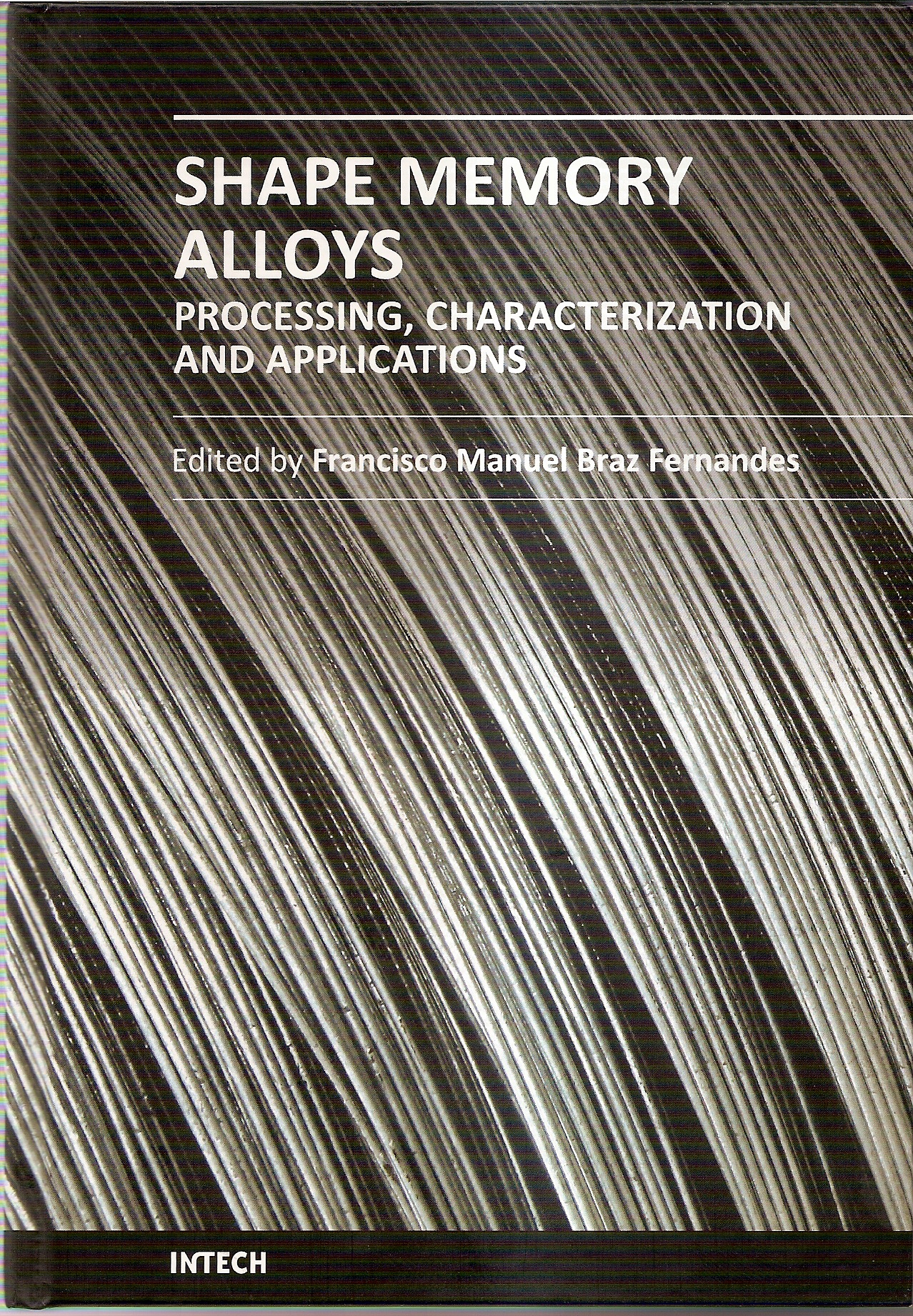
authors, Several, and Editor: Braz F. M. Fernandes Shape Memory Alloys- Processing, Characterization and Applications. 51000 Rijeka, Croatia: InTech, 2013.
Sousa, Ana M. M., João Borges, Fernando Silva, Ana M. Ramos, Eurico J. Cabrita, and Maria Pilar Gonçalves. "Shaping the molecular assemblies of native and alkali- modified agars in dilute and concentrated aqueous media via microwave-assisted extraction." Soft Matter. 9 (2013): 3131-3139. AbstractWebsite

The use of agar-based biomaterials for the development of emerging areas, such as tissue engineering or ‘smart materials’ production has recently gained great interest. Understanding how these gel-forming polysaccharides self-organise in aqueous media and how these associations can be tuned to meet the specific needs of each application is thus of great relevance. As an extension of previous pioneering research concerning the application of the microwave-assisted extraction (MAE) technique in the recovery of native (NA) and alkali-modified (AA) agars, this article focuses on the different molecular assemblies assumed by these novel NA and AA when using different MAE routes. The molecular architectures in dilute (5, 10, 50 and 100 mg mL1) and concentrated (1.5% (w/w)) aqueous media were imaged by AFM and cryoSEM, respectively. Relevant structural and physicochemical properties were investigated to support the microscopic data. Different extraction routes led to polysaccharides with unique properties, which in turn resulted in different molecular assemblies. Even at 5 mg mL1, AFM images included individual fibers, cyclic segments, aggregates and local networks. At higher polymer concentrations, the structures further aggregated forming multilayer polymeric networks for AA. The more compact and denser 3D networks of AA, imaged by cryoSEM, and their higher resistance to large deformations matched the 2D-shapes observed by AFM. Depending on the nature of the AA chains, homogeneous or heterogeneous growth of assemblies was seen during network formation. The obtained results support well the view of double helix formation followed by intensive double helix association proposed for agar gelation.

Nowacki, B., N. Paulino, and J. Goes A Simple 1 GHz Non-Overlapping Two-Phase Clock Generators for SC Circuits. 20th Int. Conf. Mixed Design of Integrated Circuits and Systems (MIXDES'2013). Gdynia, Poland: IEEE, 2013.
Tschopp, E., and O. Mateus. "The skull and neck of a new flagellicaudatan sauropod from the Morrison Formation and its implication for the evolution and ontogeny of diplodocid dinosaurs." Journal of Systematic Palaeontology. 11.7 (2013): 853-888. Abstracttschopp__mateus_2013_the_skull_and_neck_of_a_new_flagellicaudatan_sauropod_from_the_morrison.pdfWebsite

A new taxon of diplodocid sauropod, Kaatedocus siberi gen. et sp. nov., is recognized based on well-preserved cervical vertebrae and skull from the Morrison Formation (Kimmeridgian, Late Jurassic) of northern Wyoming, USA. A phylogenetic analysis places it inside Diplodocinae (Sauropoda: Flagellicaudata: Diplodocidae), as a sister taxon to a clade uniting Tornieria africana and the classical diplodocines Barosaurus lentus and Diplodocus. The taxon is diagnosed by a unique combination of plesiomorphic and derived traits, as well as the following unambiguous autapomorphies within Diplodocidae: frontals separated anteriorly by a U-shaped notch; squamosals restricted to the post-orbital region; presence of a postparietal foramen; a narrow, sharp and distinct sagittal nuchal crest; the paired basal tuber with a straight anterior edge in ventral view; anterior end of the prezygapophyses of mid- and posterior cervical vertebrae is often an anterior extension of the pre-epipophysis, which projects considerably anterior to the articular facet; anterodorsal corner of the lateral side of the posterior cervical vertebrae marked by a rugose tuberosity; posterior margin of the prezygapophyseal articular facet of posterior cervical vertebrae bordered posteriorly by conspicuous transverse sulcus; posterior cervical neural spines parallel to converging. The inclusion of K. siberi and several newly described characters into a previously published phylogenetic analysis recovers the new taxon as basal diplodocine, which concurs well with the low stratigraphical position of the holotype specimen. Dinheirosaurus and Supersaurus now represent the sister clade to Apatosaurus and Diplodocinae and therefore the most basal diplodocid genera. The geographical location in the less known northern parts of the Morrison Fm., where K. siberi was found, corroborates previous hypotheses on faunal provinces within the formation. The probable subadult ontogenetic stage of the holotype specimen allows analysis of ontogenetic changes and their influence on diplodocid phylogeny.

Moreira Felismina TC, Sharma Sanjiv, Dutra Rosa AF Noronha João PC Cass Anthony EG Sales Goreti M. F. "Smart Plastic Antibody Material (SPAM) tailored on disposable screen printed electrodes for protein recognition: application to Myoglobin detection." Biosensors and Bioelectronics. 42 (2013): 76.
Soares, João, João M. Lourenço, and Nuno Preguiça. "Software Component Replication for Improved Fault-Tolerance: Can Multicore Processors Make It Work?" Dependable Computing. Eds. Marco Vieira, and JoãoCarlos Cunha. Vol. 7869. Lecture Notes in Computer Science, 7869. Springer Berlin Heidelberg, 2013. 173-180. Abstractewdc2013.pdf

n/a

Poggi, F., and M. P. Amado Solar Energy: factor during the planning process of the city. 2º CIHEL 2013 . Lisboa, PT: LNEC, ISBN: 978-178-032-381-7, 2013.